
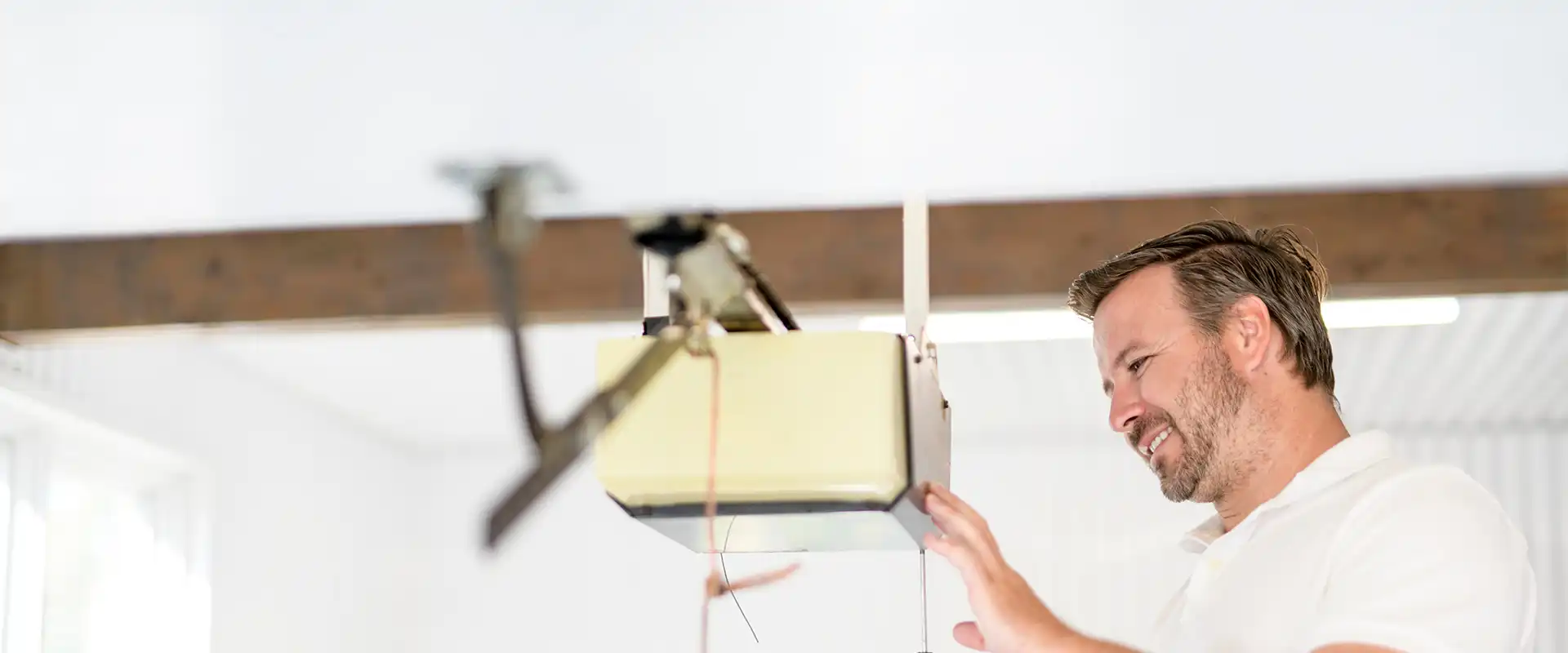
Garage Door Maintenance and Safety Guidelines
Consult the owner’s manual for additional recommended maintenance for your model of door opener. If you don’t have the owner’s manual, look for the opener model number on the back of the power unit and request a manual from the manufacturer.
Reversal Test
Make sure your opener has a reversing feature. If a reversing feature is not present, the opener should be replaced.
Garage door openers manufactured after January 1, 1993, are required by federal law to have advanced safety features that comply with the latest UL (Underwriters Laboratories) 325 standards. Contact your manufacturer or installer for additional information.
Test the reversing feature every month.
- First, test the balance of the door. If the door is properly balanced, then proceed.
- With the door fully open, place a 1-1/2″ thick piece of wood (a 2″ X 4″ laid flat) on the floor in the center of the door.
- Push the transmitter or wall button to close the door. The door must reverse when it strikes the obstruction. (Note that the bottom part of “one-piece doors” must be rigid so that the door will not close, but will reverse when it contacts the obstruction.)
- If the door does not reverse, have it repaired or replaced. Have a qualified technician adjust, repair, or replace the opener or door.
Force Setting Test
Test the force setting of your garage door opener by holding the bottom of the door as it closes. If the door does not reverse readily, the force setting may be excessive and need adjusting. See your owner’s manual for details on how to make the adjustment.
Additional Safety Devices
Many garage door openers can be equipped with additional safety devices, such as photo eyes or edge sensors, to protect against entrapment. Keep in mind that adding more safety devices will not make an old opener meet the current UL standards. Make sure the additional safety devices are properly installed and adjusted (see owner’s manual).
TESTING AND MAINTAINING THE GARAGE DOOR
Perform routine maintenance steps once a month. Review your owner’s manual for the garage door. If you don’t have a manual, look for the model number on the back of the door, or check the lock handle, hinges, or other hardware for the manufacturer’s name and request a manual from the manufacturer.
Visual Inspection
Look at the garage door springs, cables, rollers, pulleys, and other door hardware for signs of wear. If you suspect problems, have a qualified person make repairs.
WARNING – Springs are under high tension. Only qualified persons should adjust them.
Garage door springs, cables, brackets, and other hardware attached to the springs are under very high tension and, if handled improperly, can cause serious injury. Only a qualified professional or a mechanically experienced person should adjust them, but only by carefully following the manufacturer’s instructions.
The torsion springs (the springs above the door) should only be adjusted by a professional. Do not attempt to repair or adjust torsion springs yourself.
A restraining cable or other device should be installed on the extension spring (the spring along the side of the door) to help contain the spring if it breaks.
Door Balance
Periodically test the balance of your door.
- Start with the door closed.
- If you have a garage door opener, use the release mechanism so you can operate the door by hand when doing this test.
- You should be able to lift the door smoothly and with little resistance. It should stay open around three or four feet above the floor. If it does not, it is out of adjustment. Have it adjusted by a qualified service person.
This important information is provided by the U.S. Consumer Product Safety Commission, the National Safety Council, and the Industry Coalition for Automatic Garage Door Opener Safety.